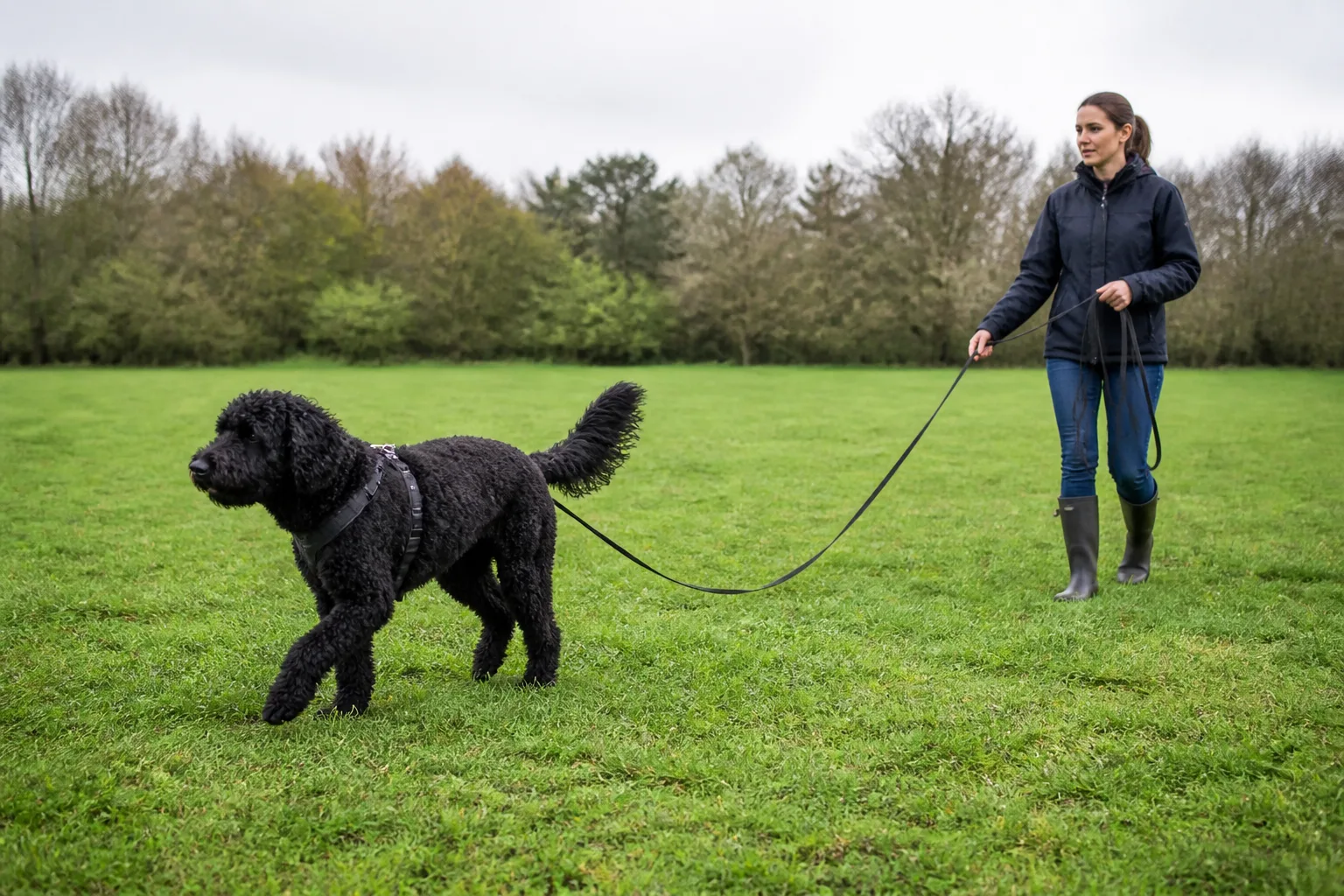
The Frustrated Greeter: Managing Leash Reactivity in Labradoodles
Is your Labradoodle aggressive or just excited? Learn to manage the 'Frustrated Greeter' and stop leash reactivity with science-based training.
The “He’s Friendly!” Trap
It is a scene every Labradoodle owner knows too well. You are walking down the street, enjoying a sunny morning. The birds are singing, your coffee is warm, and your dog is trotting happily by your side.
Then, in the distance, another dog appears.
Instantly, the Jekyll-and-Hyde transformation begins. Your relaxed, fluffy companion goes rigid. The ears prick up. The tail goes stiff and high. And then, the lunging starts. The barking is high-pitched, frantic, and relentless. You find yourself gripping the leash with both hands, feet planted, apologizing to the terrified neighbor who is crossing the street to avoid you: “I’m so sorry! He’s friendly! He just wants to say hi!”
This is Leash Reactivity. It is the number one behavioral reason Labradoodles are surrendered to rescues between the ages of 1 and 2 years old. And contrary to how it looks, it is rarely about aggression. It is about Frustration.

The Labradoodle Layer: Why Our Dogs Struggle
To solve the problem, we must understand the genetics driving it. It is not “just how dogs are.” Labradoodles are uniquely predisposed to being “Frustrated Greeters” due to the specific collision of their parent breeds.
The Labrador Side: High Social Drive
Labradors are genetically engineered to be social. They have extremely high arousal levels when it comes to meeting new pack members. A Labrador sees a stranger and thinks, “Potential best friend!” This intense desire to connect creates a massive dopamine spike. When the leash prevents them from acting on this impulse, that dopamine turns into frustration, similar to a child being held back from an ice cream truck.
The Poodle Side: Pattern Recognition
Poodles are highly intelligent and quick to learn patterns. If your dog pulls on the leash and you take even one step forward, the Poodle brain records this data point: Pulling works. Pulling gets me closer. Over time, this creates a deeply ingrained neural pathway where seeing a dog triggers an automatic motor response to lunge.
The Hybrid Result: The “Social Missile”
When you combine the Labrador’s desperate need to socialize with the Poodle’s problem-solving intelligence, you get a dog that believes the only way to satisfy their social drive is to physically pull you to the target. This behavior often starts during the critical puppy socialization window, where we mistakenly let puppies “say hi” to every dog they meet, teaching them that seeing a dog equals play.
F1 vs F1b: Does Generation Matter?
We often see a slight difference in reactivity styles based on genetics.
- F1 Labradoodles (50/50): Often have the brute strength of the Lab. Their reactivity is physical—hard pulling, dragging you toward the stimulus.
- F1b Labradoodles (75% Poodle): As discussed in our genetics guide, the higher Poodle content often correlates with higher sensitivity. These dogs are more likely to exhibit “screaming” barks and neurotic spinning when frustrated.
Diagnosis: Frustration vs. Aggression
It is critical to distinguish between a dog that wants to fight and a dog that wants to frolic. Mistaking frustration for aggression leads to incorrect training (punishment) which makes the problem worse.
Frustrated Greeter (Barrier Frustration)
- Body Language: Bouncy, ears forward, tail wagging high and fast, “play bows.”
- Vocalization: High-pitched barking or whining.
- The “Barrier” Effect: They are fine off-leash. The leash is the only thing causing the tension. It prevents them from acting on their social drive, leading to a temper tantrum 2 .
- Emotion: “I want that!”
Fear Aggression
- Body Language: Cowering, tail tucked, hackles (hair on back) raised, lip curling.
- Vocalization: Deep growling or snarling.
- Off-Leash: If the leash were dropped, they would attack or flee.
- Cause: Fear. They want the other dog to go away.
If your dog shows signs of Fear Aggression (growling, snapping), do not attempt the training below on your own. Consult a Certified Applied Animal Behaviorist (CAAB). This guide is for Frustrated Greeters only.
The Hidden Culprit: Trigger Stacking
Before we get to the training protocol, we must talk about “Trigger Stacking.” Imagine your dog has a stress bucket.
- Morning: The mailman knocks (bucket fills 10%).
- Noon: They see a squirrel (bucket fills 20%).
- Afternoon: You accidentally step on their tail (bucket fills 10%).
- Evening Walk: They see ONE dog.
Normally, seeing one dog might only fill the bucket by 30%. But because the bucket is already 40% full from the day’s events, that one dog causes the bucket to overflow. The dog explodes.
This is why reactivity seems unpredictable. “He was fine yesterday!” Yesterday, his bucket was empty. Today, it was full before you even left the house.
Management Strategy: If your dog has had a stressful day, skip the walk. Play brain games inside instead. Do not force a walk on a full bucket.
The Solution: The “Engage-Disengage” Game
You cannot punish a dog for being excited. Yanking on the collar (“leash popping”) only adds pain to the frustration. In the dog’s mind, they see another dog, they feel pain in their neck, and they start to associate other dogs with pain. This can turn a friendly Frustrated Greeter into a fear-aggressive dog.
Instead, we use a science-based protocol called Engage-Disengage to change the dog’s emotional response 3 . We want to teach them: “Seeing another dog means I should look at my owner for a treat, not pull.”
The Setup: You Need Speed
This training happens in milliseconds. You cannot fumble for treats in a plastic bag. You need a professional treat pouch that allows for rapid-fire delivery.

Rapid Rewards Treat Pouch
Magnetic closure for quick access. Essential for timing rewards perfectly during socialization.
Affiliate link. We may earn a commission.
Phase 1: The “Engage” (Look at That)
Goal: Teach the dog that the sight of a trigger (another dog) predicts a treat.
- Find Your Distance: Start far enough away that your dog notices the other dog but doesn’t react (the “Green Zone”). This might be 50 feet; it might be 200 feet.
- Mark the Look: As soon as your dog looks at the other dog, click (or say “Yes!”).
- Reward: Immediately feed a high-value treat (chicken, cheese, hot dog). Do not use kibble.
- Repeat: Dog looks at dog -> “Yes!” -> Treat.
You are conditioning a Pavlovian response. Scary/Exciting Thing = Chicken. You are not asking the dog to do anything yet. You are just paying them for noticing the world.
Phase 2: The “Disengage” (Auto-Check-in)
Once your dog understands the game (usually after 1-2 weeks of Phase 1), they will start looking at the other dog and then immediately snapping their head back to you, expecting the treat. This is the magic moment.
- Wait: When your dog sees the trigger, wait 1-2 seconds. Do not click yet.
- The Decision: Your dog will look at the other dog, realize “Where’s my click?”, and turn their head to look at you.
- Jackpot: The moment they turn to you voluntarily, mark “Yes!” and give 3-5 treats in a row.
You have now rewired the brain. The sight of another dog is no longer a cue to pull; it is a cue to look at you.
Managing Thresholds: The Traffic Light System
Success depends entirely on distance. You must keep your dog “under threshold.” This concept is similar to managing separation anxiety—if the dog is already in a panic, learning cannot happen.
- Green Zone (Thinking Brain): Dog sees trigger, ears flick, but can still eat treats and listen to you. Train here.
- Yellow Zone (Loading…): Dog stares hard, mouth closes, breathing stops for a second. Move away.
- Red Zone (Reptile Brain): Barking, lunging, not eating. Training is over.
If your dog hits the Red Zone, they are functionally deaf. Cortisol has flooded their brain. You cannot command them to “Sit.” You must perform an Emergency U-Turn.
The Emergency U-Turn
Do not ask for permission.
- Say “Let’s Go!” in a happy voice.
- Turn 180 degrees.
- Jog away until the dog follows.
- Scatter a handful of treats on the ground to diffuse the tension (sniffing lowers heart rate) 1 .
Equipment Debate: Harness vs. Collar
One of the most common questions we get is about equipment. Should you walk a reactive Labradoodle on a harness or a collar?
The Pros
- • Protects the trachea from collapse (vital for pullers)
- • Prevents increased intraocular pressure
- • Harder to escape from (if using a 3-point harness)
The Cons
- • Can trigger the 'opposition reflex' (sled dog effect)
- • Gives you less control over the head
- • Some dogs find the fit aversive
Our Verdict: For Frustrated Greeters, we recommend a Front-Clip Harness. A back-clip harness encourages pulling. A collar puts dangerous pressure on the throat. A front-clip harness gently turns the dog’s body toward you when they pull, mechanically disrupting the behavior without pain.
For recall and lower-pressure exploration away from busy sidewalks, use our long-line and harness selection guide. It covers fit, coat friction, materials, and avoiding high-speed stops.
Troubleshooting Common Scenarios
1. The “Off-Leash Dog” Nightmare
You are training perfectly, and suddenly a loose dog runs up to you.
- Do not pick up your dog: This triggers the other dog’s prey drive to jump.
- Throw a “Treat Bomb”: Throw a handful of treats at the face of the oncoming dog. While they are startled and eating, escape.
2. The Rude Neighbor
“Can my dog say hi?”
- Be firm: “No, we are training.”
- Body Block: Stand between your dog and the approaching person.
- Do not apologize: You are your dog’s advocate.
Post-Walk Decompression
A reactive walk is physically exhausting for your dog. Their cortisol levels can stay elevated for up to 72 hours. After a bad walk, engage in decompression activities:
- Licking: A frozen Kong or Lick Mat releases endorphins.
- Chewing: A bully stick or yak chew.
- Sniffing: Hide treats around the living room.
Conclusion
Leash reactivity is not a life sentence. It is a communication gap. Your Labradoodle is shouting, “I want to say hi!” and you are shouting, “Stop it!”
By using the Engage-Disengage game, you act as a translator. You validate their feelings (“I see the dog too”) and give them a new job (“Look at me”). With consistency and a well-stocked treat pouch, you can turn your Frustrated Greeter into a Zen Master.