F1 vs F1b Labradoodles: The Genetics Explained
The definitive guide to generation math. Which generation is actually hypoallergenic? We break down the DNA percentages.
F1 vs F1b Labradoodles: The Genetics Explained
If you’ve researched Labradoodles, you’ve encountered the alphabet soup of generations: F1, F1b, F2, F2b, and multigens. Breeders throw these terms around, but what do they actually mean? More importantly—which one should you get if allergies are a concern?
Let’s cut through the marketing and look at the genetics.
Understanding the F1 Generation
An F1 Labradoodle is the first-generation cross between a purebred Labrador Retriever and a purebred Poodle 1 .
The math is simple:
- 50% Labrador Retriever
- 50% Poodle
This is as straightforward as breeding gets. However, this 50/50 split creates significant variability in coat type. An F1 Labradoodle might inherit:
- A fleece coat (wavy, low-shedding) — ideal outcome
- A hair coat (straight, shedding) — similar to a Lab
- A wool coat (curly, minimal shedding) — similar to a Poodle
The texture differences are vast; for a detailed comparison of maintenance for each, see our breakdown of Labradoodle Coat Types.
The coat type is largely determined by genetics at the KRT71 gene (the “curl gene”) and the MC5R gene (associated with shedding) 2 . Since an F1 is a genetic coin flip, predicting the coat outcome—and potential carrier status for conditions like Von Willebrand’s Disease—is inherently uncertain without testing.
Who Should Consider an F1?
F1 Labradoodles work well for:
- Families with mild or no allergies
- Those who want a balanced temperament (often slightly less prone to separation anxiety than higher-percentage Poodle crosses)
- Buyers who are comfortable with coat variability
They are not recommended for families with moderate to severe pet allergies.
Understanding the F1b Generation
An F1b Labradoodle is a backcross—the result of breeding an F1 Labradoodle back to a purebred Poodle.
The math:
- 25% Labrador Retriever
- 75% Poodle
This higher Poodle percentage significantly increases the likelihood of a non-shedding, hypoallergenic coat. The F1b generation is where breeders gain more predictability.
Why F1b Is Often Recommended for Allergies
The increased Poodle genetics mean:
- Higher probability of inheriting the curl gene variant
- Reduced likelihood of the shedding gene expression
- More consistent coat texture (usually fleece or wool)
However, “hypoallergenic” is not a guarantee. No dog is 100% allergy-free. People with allergies react to proteins in dog saliva and dander (Can f 1 and Can f 2), not fur itself. A non-shedding coat simply reduces the spread of these allergens.
Who Should Consider an F1b?
F1b Labradoodles are recommended for:
- Families with moderate allergies
- Those prioritizing a non-shedding coat
- Buyers who want higher coat predictability
The Role of DNA Testing
Here’s the uncomfortable truth: you cannot reliably predict a puppy’s coat type by looking at it at 8 weeks old. Coat texture can change dramatically between puppyhood and adulthood.
The only way to know for certain what genes a puppy carries is through DNA testing. Reputable breeders test their breeding dogs for coat genetics, including:
- KRT71 — Curl gene (determines wavy vs. straight vs. curly)
- MC5R — Associated with shedding propensity
- FGF5 — Furnishings gene (determines “doodle look” with beard and eyebrows)
Crucially, they should also test for coat color genetics, including the M Locus (Merle), as improper breeding of merle Labradoodles can lead to severe health defects. Additionally, because higher Poodle genetics (like in F1b) can increase the risk of recessive conditions such as Sebaceous Adenitis or Exercise Induced Collapse, comprehensive health screening is non-negotiable. Breeders must also screen for Progressive Retinal Atrophy, which is prevalent in the Poodle line.
If you’ve already brought home your Labradoodle and want to understand their genetic makeup, a DNA test can provide clarity.
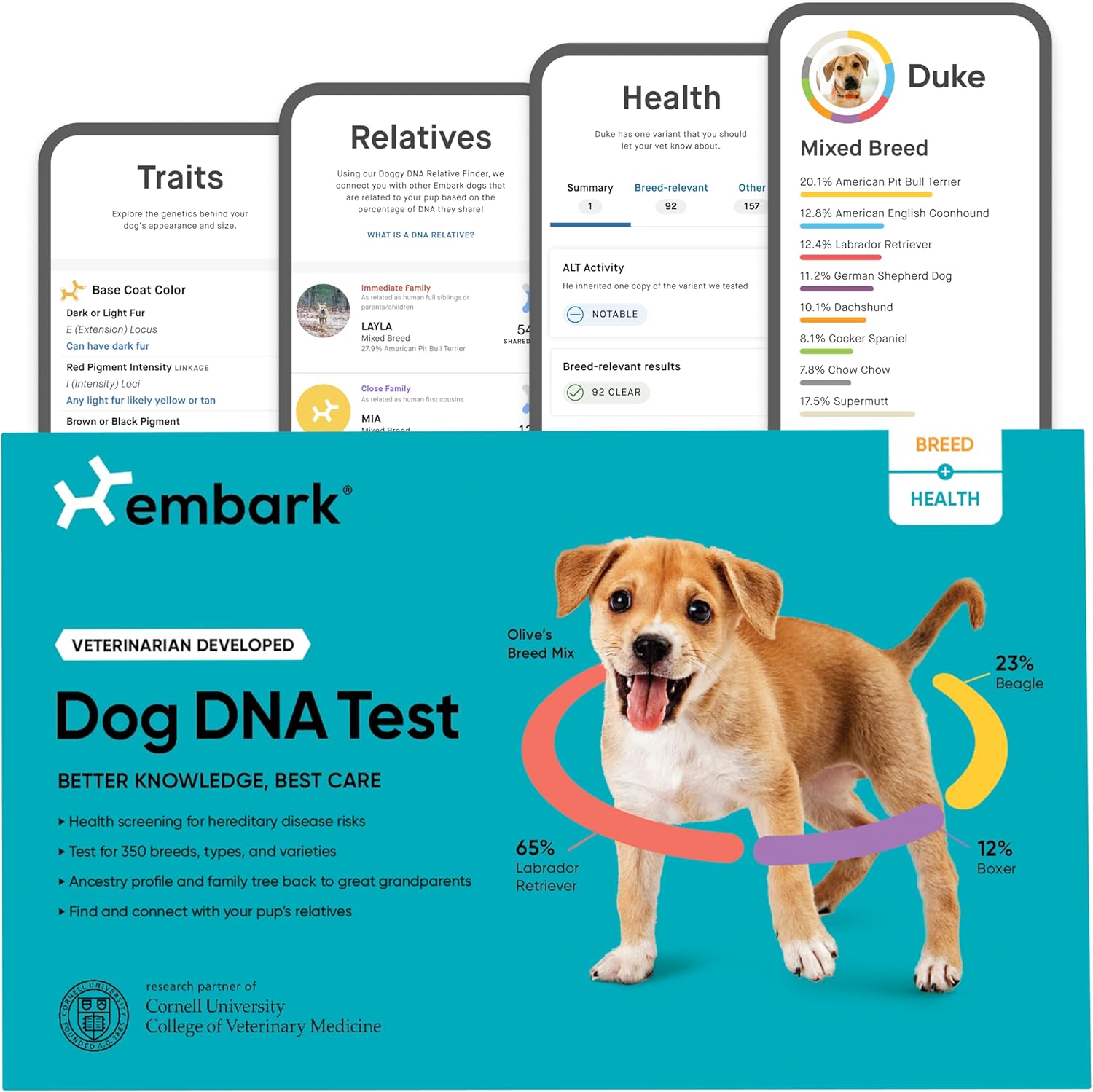
Embark Breed + Health Kit
An at-home breed and health DNA panel. Review its current variant coverage and use results alongside clinical screening and veterinary care.
Affiliate link. We may earn a commission.
The Embark test screens for over 230 genetic health conditions in addition to breed identification. For a complete breakdown of what these tests reveal—including the specific risks for Poodle mixes—read our guide on Genetic Health Testing.
Comparing F1 vs F1b: Quick Reference
| Factor | F1 | F1b |
|---|---|---|
| Poodle Genetics | 50% | 75% |
| Labrador Genetics | 50% | 25% |
| Coat Predictability | Low | Moderate-High |
| Shedding Risk | Moderate | Low |
| Allergy-Friendly | Unpredictable | More likely |
| Price Range | $$-$$$ | $$$-$$$$ |
Beyond F1b: Other Generations
For completeness, here’s how other generations are calculated:
- F2: F1 × F1 = 50% Poodle / 50% Lab (same as F1, but with more genetic variability)
- F2b: F1 × F1b = 62.5% Poodle / 37.5% Lab
- F3 / Multigen: Multiple generations of Labradoodle × Labradoodle breeding
Multigenerational Labradoodles, when bred responsibly, can offer the most coat consistency. However, they require breeders to maintain meticulous genetic records across multiple generations.
The Bottom Line
Choosing between F1 and F1b depends on your priorities:
Choose F1 if:
- You have no family members with dog allergies
- You want a balanced Lab/Poodle temperament
- You’re prepared for coat variability
Choose F1b if:
- Someone in your household has allergies
- You need a non-shedding dog
- Coat predictability is important to you
Regardless of generation, always request genetic testing documentation from your breeder. A responsible breeder will have OFA health clearances and coat genetics on file for their breeding dogs.
Have questions about Labradoodle genetics? Our guides on coat types and health testing go deeper into what to look for before bringing home your puppy.