Progressive Retinal Atrophy (PRA) in Labradoodles: The Silent Genetic Threat
A comprehensive guide to PRA in Labradoodles. Understand genetic risks, early symptoms like night blindness, and why DNA testing is critical for this breed.
When the Lights Go Out
Imagine slowly losing your ability to see in the dark. A familiar hallway becomes an obstacle course; the backyard at night transforms into a scary, undefined void. This is the reality for Labradoodles affected by Progressive Retinal Atrophy (PRA).

PRA is not an infection, an injury, or an inevitable part of aging. It is a group of degenerative diseases that affect the photoreceptor cells in the eyes. Slowly, painlessly, and irreversibly, it leads to blindness.
For Labradoodle owners, PRA is a significant concern because it affects both parent breeds—the Labrador Retriever and the Poodle. This creates a “double jeopardy” scenario where the vaunted “hybrid vigor” of the doodle can actually fail if not managed by rigorous genetic testing.
What is Progressive Retinal Atrophy?
The retina, located at the back of the eye, is like the film in a camera (or the sensor in a digital one). It captures light and converts it into electrical signals that the brain interprets as vision. The retina contains two types of photoreceptor cells:
- Rods: Responsible for vision in low light (night vision) and detecting motion.
- Cones: Responsible for vision in bright light (day vision) and color perception.
In dogs with PRA, these cells deteriorate and die. The most common form seen in Labradoodles is Progressive Rod-Cone Degeneration (prcd-PRA). As the name suggests, the rod cells fail first, followed eventually by the cone cells 1 .
The Progression Timeline
The disease usually presents in young adulthood to middle age (3-6 years old), though the genetic programming is present from birth.
- Early Stage (Night Blindness): The dog becomes hesitant to go outside at night or bumps into furniture in dim light. They may stand frozen at the back door, afraid to step into the dark yard.
- Mid Stage (Tunnel Vision): Peripheral vision begins to fail. The pupils may appear dilated even in daylight as the eyes desperately try to let in more light. The dog might startle easily if approached from the side.
- Late Stage (Total Blindness): The lens may become cloudy (secondary cataracts) due to toxic byproducts from the dying retina. Eventually, day vision is lost completely.
PRA is painless. If your dog is squinting, rubbing their eyes, tearing up, or has red eyes, this is likely NOT PRA. Painful eyes usually indicate glaucoma, uveitis, or a corneal ulcer. See a vet immediately.
The Genetic Mechanism: A Recessive Assassin
Understanding the genetics of PRA is crucial for every Labradoodle buyer and breeder. prcd-PRA is an autosomal recessive trait. This is simple Mendelian genetics in action, but with high stakes.
“Recessive” means the gene can hide. A dog can carry the mutation without ever showing symptoms. For a dog to develop the disease, they must inherit two copies of the mutated gene—one from the mother and one from the father.
The Three Genetic Statuses
- Clear (Normal): Has two normal genes. This dog will not get PRA and cannot pass the mutation to its offspring.
- Carrier: Has one normal gene and one mutated gene. This dog will NOT get PRA and has normal vision. However, it has a 50% chance of passing the bad gene to each puppy.
- Affected: Has two mutated genes. This dog WILL develop PRA and go blind. It will pass the mutated gene to 100% of its offspring.
The Risk Matrix:
- Clear x Clear: 100% Clear puppies. (Safe)
- Clear x Carrier: 50% Clear, 50% Carrier. (Safe from disease, but produces carriers)
- Carrier x Carrier: 25% Clear, 50% Carrier, 25% Affected. (Unsafe Breeding)
- Carrier x Affected: 50% Carrier, 50% Affected. (Highly Unethical)
The Labradoodle Layer: Hybrid Vigor vs. Genetic Reality
A common myth in the doodle world is that mixed breeds are healthier than purebreds due to “hybrid vigor” (heterosis). While true that mixing gene pools can eliminate some breed-specific issues caused by inbreeding, it does not protect against recessive diseases shared by both parent breeds.
Labradoodles are at a unique disadvantage regarding PRA because the prcd mutation is prevalent in both Poodles and Labrador Retrievers 2 . Unlike polygenic conditions like Hip Dysplasia where environment plays a role, PRA is purely genetic.
- Poodles (Standard, Miniature, and Toy): High prevalence of prcd-PRA.
- Labrador Retrievers: Significant prevalence of prcd-PRA.
If a breeder mates a Poodle carrier to a Labrador carrier, the resulting F1 Labradoodle puppies have a 1 in 4 chance of going blind. This helps explain why F1 Labradoodles, despite being the “most hybrid,” are not immune to genetic defects. This is why “vet checked” is not enough. A standard veterinary exam cannot see DNA. Only genetic testing can prevent this tragedy.
Differentiating PRA from Other Eye Conditions
Owners often confuse PRA with other common eye issues. It is vital to get a correct diagnosis.

PRA vs. Cataracts
- Cataracts: An opacity or cloudiness in the lens of the eye. It blocks light from reaching the retina. Cataracts can be surgical removed to restore vision.
- PRA: The death of the retina itself. Even if the lens is clear, the “film” is broken. There is no surgery to fix PRA. Note: Dogs with PRA often develop secondary cataracts, complicating the diagnosis.
PRA vs. Retinal Dysplasia
- Retinal Dysplasia: A malformation of the retina that occurs in utero. The puppy is born with vision defects. It is usually non-progressive (it doesn’t get worse).
- PRA: The retina forms normally, then degenerates later in life. It is progressive (it gets worse).
Symptoms: What to Watch For
Because PRA is slow-moving, dogs are masters at compensating. They memorize the layout of the house (a “cognitive map”) and rely heavily on their hearing and smell. Owners often don’t notice anything is wrong until the disease is advanced or the furniture is rearranged.
Key Warning Signs:
- Nyctalopia (Night Blindness): The hallmark sign. Your dog refuses to go out for the last potty break, hugs the wall in dim hallways, or trips over things only at night.
- “Glow” in the Eyes: You may notice increased “eye shine” (tapetal reflection). The tapetum lucidum is the reflective layer behind the retina (what makes eyes glow in photos). As the retina thins, more light hits the tapetum and reflects back, making the eyes look like they are glowing green or gold, even in ambient light.
- Dilated Pupils: Pupils remain large even in lit rooms.
- Hesitancy: Reluctance to jump off the bed, get into the car, or navigate stairs.
- Clinginess: A formerly independent dog may become “velcro,” sticking close to your legs for guidance.
Diagnosis: Certainty Through Science
If you suspect vision loss, do not wait. While PRA cannot be cured, knowing the diagnosis allows you to prepare. Your general practice vet can perform a basic menace response test (waving a hand towards the eye) and check for pupil reflexes. However, a definitive diagnosis usually requires:
- DNA Testing: The gold standard for prcd-PRA. A simple cheek swab can confirm if your dog is genetically affected. This can be done at any age, even in puppies.
- Electroretinography (ERG): Performed by a veterinary ophthalmologist. This tests the electrical response of the retina to light flashes. It is the only way to diagnose non-prcd forms of PRA or to confirm the disease is active before visible changes occur in the eye exam 3 .
The Role of DNA Testing
If you are buying a puppy, demand to see the parents’ PRA test results. At least one parent must be “Clear” to guarantee the puppies will not be affected. A responsible breeder will show you the official laboratory report (from Embark, Paw Print Genetics, or similar).
If you already have a Labradoodle and don’t know their status, testing gives you the power of knowledge.
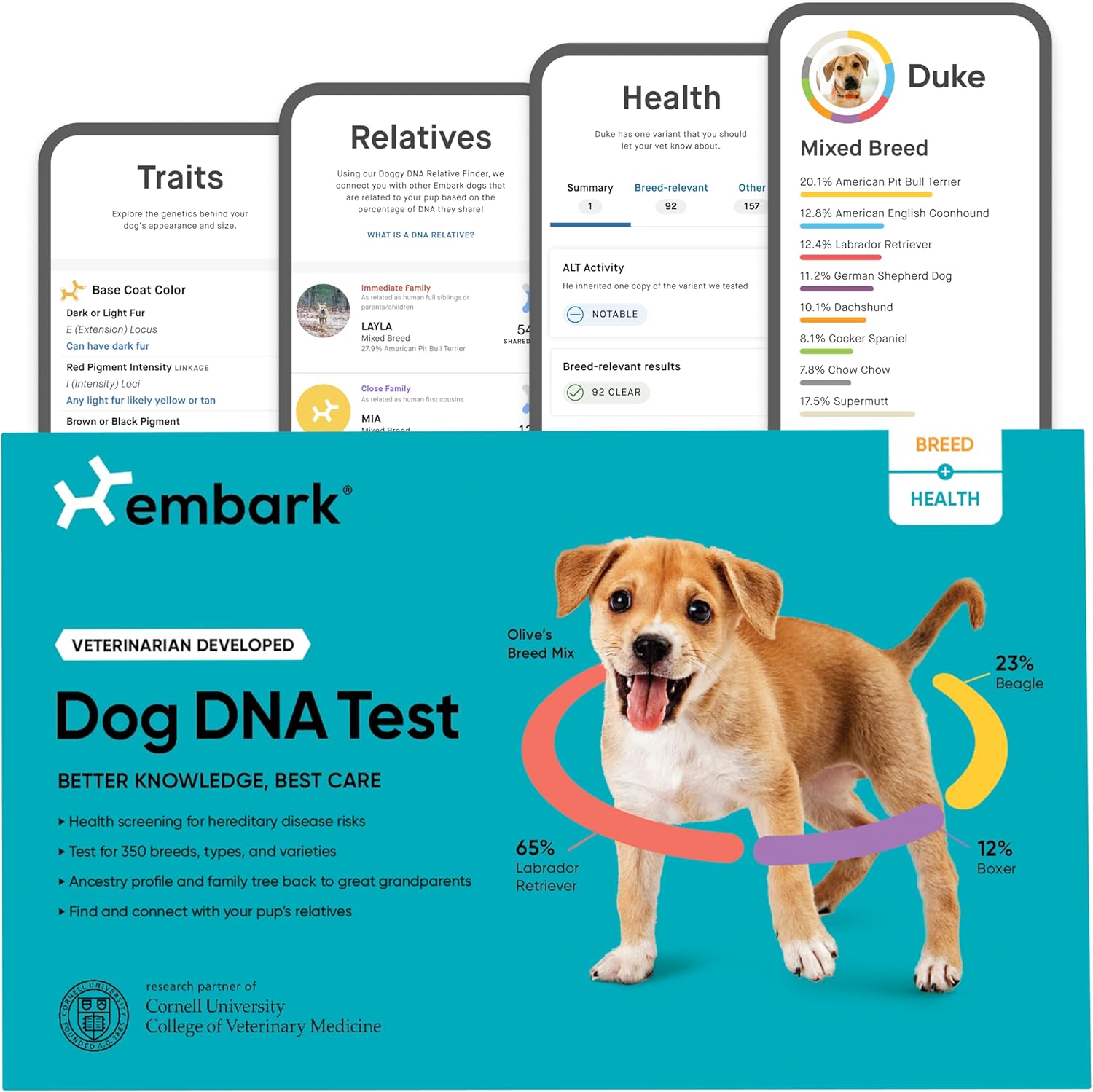
Embark Breed + Health Kit
An at-home breed and health DNA panel. Review its current variant coverage and use results alongside clinical screening and veterinary care.
Affiliate link. We may earn a commission.
We recommend the Embark Breed + Health Kit because it specifically tests for the prcd-PRA mutation common in Labradoodles, along with 200+ other genetic risks (including EIC and vWD). Knowing your dog’s status allows you to monitor them closely and adapt their environment before they lose their sight.
Living with a Blind Labradoodle
A diagnosis of PRA is heartbreaking, but it is not a death sentence. Dogs are incredibly resilient. Unlike humans, they don’t depend solely on sight; they “see” the world through their nose and ears. A blind dog can live a happy, full life.

Management Strategies:
- Consistency is Key: Do not rearrange the furniture. Keep the food and water bowls in the exact same spot.
- Safety First: Block off stairs with baby gates. Fence in pools or bodies of water. Cover sharp corners on coffee tables.
- Grooming: Continue with your regular grooming routine. A clean face (especially around the eyes) is still important for comfort, even if the eyes don’t work perfectly.
- Scent Markers: Use specific scents to mark doorways or danger zones. For example, dab a little vanilla extract on the door jambs and a little lavender oil at the top of the stairs. The dog will learn to associate the scent with the location.
- Texture Cues: Place textured mats (like a yoga mat or a rug with a specific feel) at the bottom of stairs or before obstacles. The tactile change alerts the dog to slow down.
- The “Halo”: Special harnesses with a lightweight protective hoop can prevent your dog from bumping their head into walls.
- Vocal Commands: Teach new cues like “Step up,” “Step down,” “Stop,” and “Slow.”
The Pros
- • Pain-free condition
- • Slow progression allows adaptation
- • Normal life expectancy
- • Dog remains happy and active
The Cons
- • Irreversible blindness
- • Requires environmental management
- • Safety risks outdoors
- • Loss of fetch/visual games
The Ethical Imperative
PRA is entirely preventable. There is no excuse for producing a Labradoodle with this condition in 2026. The test is cheap, easy, and widely available.
Ethical breeding isn’t just about cute puppies; it’s about ensuring those puppies have the quality of life they deserve. By understanding PRA and supporting breeders who test for it, we can eliminate this “silent darkness” from the Labradoodle population forever.
If you own a Labradoodle, love them for who they are—vision or not. Their tail will still wag when you walk in the door, they will still love a good belly rub, and they will still be your best friend. That, ultimately, is what matters most.